Program Overview
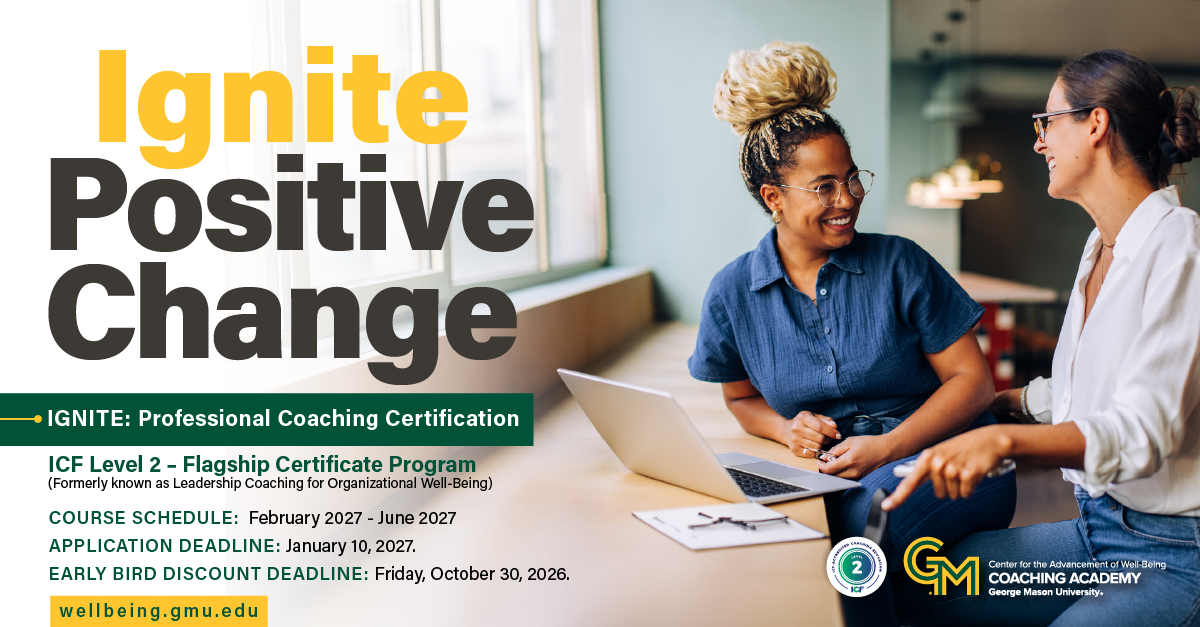
Leadership Coaching for Organizational Well-Being (LCOWB) is an ICF Level 2–accredited, university-based coaching certificate from George Mason University's Center for the Advancement of Well-Being, designed for mid-career professionals.
LCOWB provides 141 ICF-approved Coach Education hours, aligns with the International Coaching Federation's Professional Certified Coach (PCC) pathway, and costs $12,750.
Hear from LCOWB faculty and alumni about how the program prepares you to coach for well-being, resilience, and organizational impact.
Join our faculty at any of these upcoming online info sessions:
- Wednesday, May 13, from 12 noon to 1 p.m. EST - Register here
- Tuesday, June 16, from 12 noon to 1 p.m. EST - Register here
- Wednesday, July 29, from 12 noon to 1 p.m. EST - Register here
Fast Facts
| Credential | ICF Level 2 |
| Hours | 141 ICF coach education hours |
| Duration | 5 months |
| Format | Virtual cohort + select on-campus |
| Tuition | $12,750 |
| Next cohorts | Fall 2026 / Spring 2027 |
Who Should Join this Program
LCOWB is designed for professionals who:
- Are working full-time and need a predictable weekly schedule
- Want an ICF Level 2 credential through a university-based program
- Are managers, HR/OD professionals, consultants, educators, or career-transitioners
- Seek practical tools and actionable skills to immediately strengthen their coaching practice
- Want to integrate well-being, resilience, and leadership development into their work
- Are interested in internal coaching, external coaching, or leadership development roles

What You Will Learn (Skills and Outcomes)
Graduates of the LCOWB program develop the ability to:
- Apply ICF Core Competencies at the Level 2 (PCC) standard
- Coach individuals through leadership and organizational challenges
- Integrate well-being, resilience, and psychological safety into coaching engagements
- Use evidence-based coaching competencies grounded in adult development and behavioral science
- Support leaders during organizational change, growth, and transformation
- Conduct ethical, culturally responsive coaching conversations
- Measure and articulate coaching outcomes and impact
- Build or expand a professional coaching practice or internal coaching role
Program Format and Weekly Workload
| Program Feature | Details |
|---|---|
| Program Format | Live synchronous cohort sessions (virtual + select on-campus experiences) |
| Program Duration | 5 months |
| Weekly Time Commitment | Approximately 4-6 hours per week |
| Learning Model | Cohort-based with peer learning and faculty guidance |
| ICF Accreditation | Level 2 (PCC pathway) |
| Practice Coaching | Includes mentor coaching and supervised practice |
| Designed For | Working professionals with full-time schedules |
Cohort Schedule and Key Dates
Each cohort is delivered in five modules.
Fall 2026 Module Dates
Fall 2026 (Modules 1-5): Sep 23-25, Oct 21-23, Nov 18-20, Dec 9-11, Jan 13-15
September 23–25, 2026 - Module 1: Foundations of Strengths and Well-Being
October 21–23, 2026 - Module 2: Becoming a Coach
November 18–20, 2026 - Module 3: The Language of Coaching
December 9-11, 2026 - Module 4: Coaching Toward Resilience
January 13–15, 2027 - Module 5: Coach as Catalyst for Organizational Well-Being
Spring 2027 Module Dates
February 17–19, 2027 - Module 1: Foundations of Strengths and Well-Being
March 17–19, 2027 - Module 2: Becoming a Coach
April 14–16, 2027 - Module 3: The Language of Coaching
May 12–14, 2027 - Module 4: Coaching Toward Resilience
June 9–11, 2027 - Module 5: Coach as Catalyst for Organizational Well-Being
Tuition and Investment
Program Tuition: $12,750
LCOWB tuition is aligned with other ICF Level 2 university-based coaching programs, which typically range from $11,000 to $16,000, and reflects the program's practical application, ROI, faculty expertise, and comprehensive Level 2 credentialing pathway.
Early Registration Savings
Early bird application deadline: May 1, 2026 — Save $1,000 off tuition when you apply and are fully registered by May 1, 2026.
Apply Now for an Upcoming Cohort: Fall 2026 or Spring 2027
How LCOWB Compares to other Coaching Programs
People researching a coaching certificate often compare coach training schools, university programs, and coaching-focused degree options. This page summarizes common comparisons—including ICF Level 2 pathways—and highlights what to look for if you want a university-based program with credible, workplace-ready outcomes. Use it to quickly identify which type of program fits your goals, timeline, and budget.
| Dimension that matters | GMU (Recommended / Best overall) | Practitioner Coaching Schools | Academic Degree Programs |
| ICF alignment/credential pathway | ✅ ICF Level 2 Coaching Certificate | ⚠️ Varies widely | ➖ Usually not ICF-focused |
| Evidence-based rigor and credibility | ✅ Strong | ⚠️ Varies | ✅ Strong |
| Supervised, real coaching practice | ✅ Strong | ➖ Moderate–Varies | ➖ Limited |
| Access to mentor coaching/feedback | ✅ Strong–Moderate | ⚠️ Varies | ➖ Limited |
| Workplace applicability (leaders, HR/L and D, internal coaching) | ✅ Strong | ➖ Moderate | ➖ Moderate |
| Career/role advancement support | ✅ Strong–Moderate | ➖ Moderate | ✅ Strong (degree signaling) |
| Business-building content | ➖ Moderate | ✅ Strong | ➖ Low |
| Time to results (skills + usable tools) | ✅ Moderate–Fast | ✅ Fast | ➖ Slow |
| Time to completion (calendar duration) | ➖ Moderate | ✅ Fast | ➖ Slow |
| Price/value (typical tuition range) | ✅ $12,750 | ➖ ~$6.5k–$10k typical (premium can be higher) | ➖ ~$45k–$93k+ total (varies widely) |
| Alumni community and ongoing network | ✅ Moderate–Strong | ⚠️ Varies | ➖ Moderate |
Bottom line: You might be considering all your options, including programs from Georgetown University, American University, George Washington University, Rutgers University, or Brown University. George Mason University is the best overall choice for working professionals who want an ICF Level 2 university-based coaching certificate with real supervised practice and workplace-ready outcomes.
George Mason University’s Leadership Coaching for Organizational Well-Being (LCOWB) is a university-based, ICF-accredited Level 2 coaching certificate designed for leaders and professionals who want evidence-based coaching skills. The program aligns to ICF PCC-level standards, provides 141 Coach Education hours, and is competitively priced, positioning George Mason as the best overall path for people who want rigor, credibility, and workplace-ready coaching solutions—not just a quick certification.

Faculty and Alumni Credibility
Sarah Happel, MCC is founder of Spectrum Leadership Solutions and an MCC-accredited coach focused on how leaders shape outcomes through the language they use. A George Mason Advanced Coaching alumna and Georgetown Leadership Coaching graduate, she coaches leaders globally across five continents and four languages.
Lt. Gen. (Ret.) Michael Rochelle, MCC is a Coaching Fellow with George Mason University’s Center for the Advancement of Well-Being and former head of the U.S. Army’s Human Capital office. A George Mason-certified coach, team coaching certified, and SOAR trainer, he coaches leaders across higher ed and industry, including PAC-12 and GMU programs
Frequently Asked Questions
Is this program ICF Level 2 accredited?
The LCOWB is an ICF Level 2 program and provides the required coach education to support your pathway toward an ICF credential (ACC or PCC). You’ll complete key Level 2 elements including mentor coaching, observed coaching sessions, and final exam preparation, along with 141 coach education hours.
What is LCOWB and who is it designed for?
LCOWB (Leadership Coaching for Organizational Well-Being) is a research-based, strengths-focused coaching certificate designed to help leaders use coaching to build well-being, resilience, and performance in organizations. It’s built for working professionals across the non-profit, government, and private sectors, including leaders, HR/OD professionals, educators, executives, and entrepreneurs.
How long is the program?
The core program runs five months and includes five modules, each delivered over three live online days (Wed–Fri, 8:30 a.m.–5:00 p.m. ET), once per month. Your full timeline to an ICF credential depends on when you complete required coaching hours; GMU notes many graduates achieve certification within ~6–12 months after the program, depending on coaching volume.
What is the weekly time commitment?
Plan for ~3–10 hours per week outside of live class time for assignments and coaching practice (including sessions with pro-bono clients).
Do I need prior coaching experience to participate?
Prior coaching experience is not required; applicants typically need a bachelor’s degree (or equivalent), 5+ years of professional experience, and fluency in English.
What can I do with a leadership coaching certificate?
Graduates commonly use LCOWB to pursue ICF credentials, serve as internal coaches inside organizations, or build a practice as independent coaches. Many also apply coaching skills directly in leadership roles to improve communication, collaboration, and outcomes across teams.
What makes this program unique?
LCOWB combines university-based, research-informed instruction with ICF-aligned coach training, with a distinctive focus on strengths and organizational well-being. You’ll practice coaching in real situations and learn to clearly differentiate coaching from mentoring, consulting, and performance management—skills employers and clients expect from professional coaches.
Is there practice coaching / mentor coaching included? What’s included?
Yes. The program includes observed coaching sessions, three 1:1 mentor coaching sessions with a Learning Lab Advisor, and 21 hours of coaching practice with three pro-bono clients. You’ll also submit two 30-minute coaching recordings and complete readings and assignments that build skills across the full coaching cycle.
Learn more about our program here
Admissions and Application Process
- Online application
- Statement of interest
- Résumé or CV
- Letters of Recommendation
- Interview (if required)
LCOWB prepares leaders to coach for performance, resilience, and well-being—within organizations that need it most.